Most workshops that complain about chipped laminate, burnt edges or short blade life blame the machine. In many cases the machine is fine and the blade is wrong. The saw blade is the only part of a panel saw that touches your material, and its tooth design decides how cleanly each board is cut, how long the blade lasts, and how much rework your edge banding and finishing teams inherit.
At Kataria Tech Zone, we supply panel saws and related woodworking machinery to furniture and cabinet manufacturers across India. One of the most common questions we hear from buyers is: “Should I use an ATB blade or a TCG blade?” The honest answer is that it depends on what you cut, and this guide explains how to decide.
Why Tooth Design Matters on a Panel Saw
A panel saw is built for accuracy and volume. A sliding table panel saw may break down dozens of full sheets in a shift, and every one of those cuts becomes a visible edge on a wardrobe, kitchen cabinet or office desk.
Tooth design affects four things directly:
- Edge quality. Clean, chip-free edges mean less sanding and better edge banding adhesion.
- Blade life. The wrong geometry wears carbide faster, especially on abrasive boards.
- Feed rate and load on the motor. A blade that fits the material cuts freely at production speed.
- Operator safety. A mismatched blade is more likely to grab, vibrate or kick back.
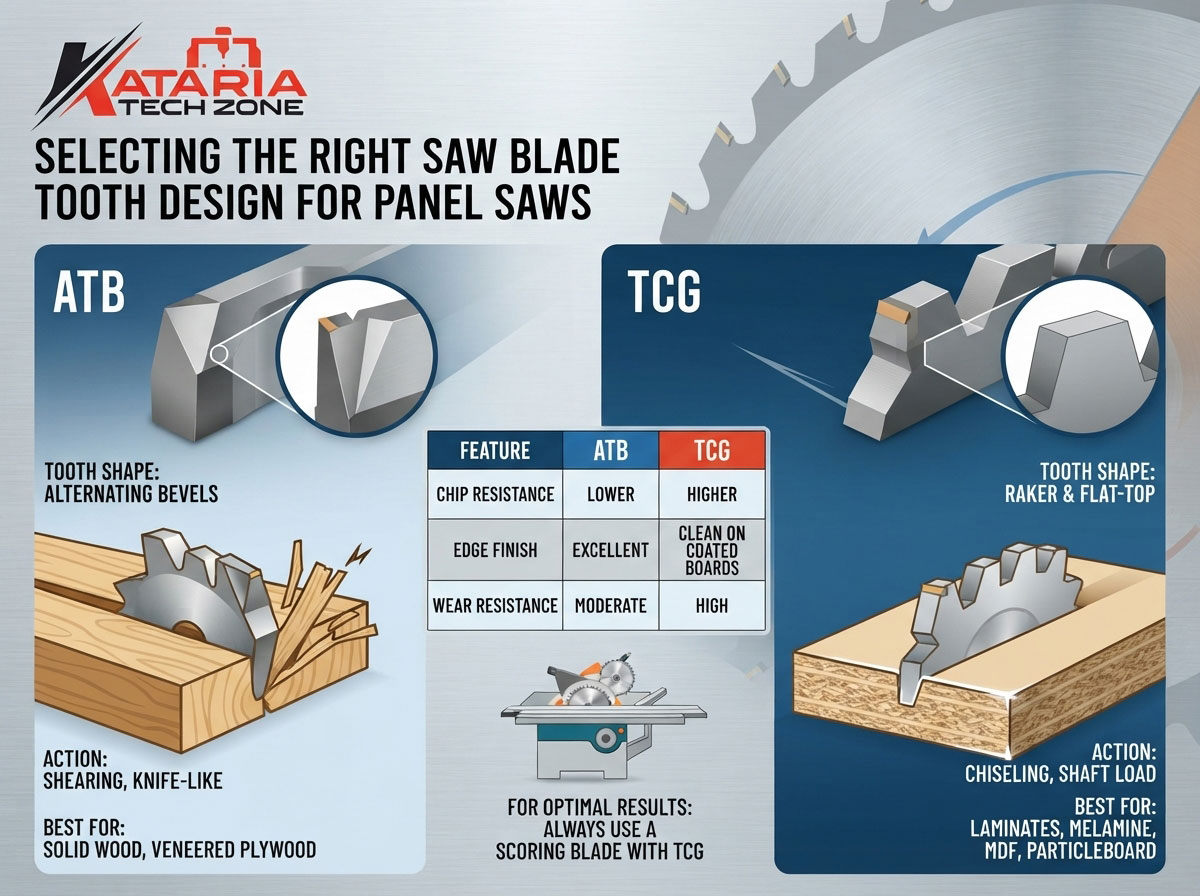
The two designs you will meet most often are ATB (Alternate Top Bevel) and TCG (Triple Chip Grind). Both are made for panel work, but they are built for different materials.
What Is an ATB Saw Blade?
On an ATB blade, the top of each tooth is ground at an angle, and the bevel alternates left, right, left, right around the blade. Each tooth acts like a small knife, slicing wood fibers cleanly on both sides of the kerf instead of tearing them.
Key features of ATB blades
- Sharp, pointed tooth tips that shear fibers cleanly
- Typical top bevel angles of roughly 10° to 30° for general use
- Excellent crosscut finish on natural wood and veneered boards
- A sharp edge that dulls faster on abrasive materials than a TCG tooth
High ATB (Hi-ATB)
A Hi-ATB blade uses a steeper bevel, often in the 30° to 40° range. It gives a very fine finish on veneered plywood and some decorative panels, but the sharper tooth point is more delicate. It suits clean, careful work rather than rough-and-tumble production on abrasive boards.
Where ATB works best
- Solid wood and timber panels
- Veneered plywood and veneered MDF where a fine face-side finish matters
- Natural wood crosscutting on a combination or sliding table saw
What Is a TCG Saw Blade?
A TCG blade alternates two different tooth shapes. The first is a trapezoidal raker tooth, which has a flat top with chamfered corners and makes the initial cut. The second is a flat-top tooth, which follows behind and cleans the kerf. The raker removes the bulk of the material, and the flat tooth finishes the cut, so the load is shared across two teeth.
Key features of TCG blades
- Tougher, more wear-resistant tooth geometry
- Resists chipping on hard, brittle or abrasive surfaces
- Gives clean bottom and top edges on coated and laminated boards
- Slightly slower, heavier cutting action than a sharp ATB blade, which is a worthwhile trade for durability
Where TCG works best
- Melamine-faced and laminated boards
- High-pressure laminate (HPL)
- Particleboard, MDF and other abrasive engineered boards
- Some non-ferrous materials and plastics, where the blade is specified for them
For panel saws in modular furniture production, where most boards are laminated, TCG is often the workhorse blade.
ATB vs TCG: Side-by-Side Comparison
| Feature | ATB | TCG |
|---|---|---|
| Tooth shape | Alternating angled bevels | Alternating raker and flat-top teeth |
| Cutting action | Shearing, knife-like | Chiseling, load shared between two teeth |
| Best materials | Solid wood, veneered plywood | Laminates, melamine, MDF, particleboard |
| Finish on coated boards | Can chip the laminate layer | Clean and chip-resistant |
| Wear resistance | Moderate | High |
| Sensitivity to abrasion | Higher | Lower |
| Typical use | Fine crosscutting of natural wood | Production cutting of engineered boards |
A simple rule of thumb: if your material is natural wood or wood veneer, start with ATB. If it is laminated, melamine-faced or abrasive, start with TCG.
Other Blade Variables That Matter as Much as Tooth Design
Choosing ATB or TCG is only part of the decision. Three more factors change how a blade performs.
1. Tooth count
Tooth count controls the balance between finish quality and cutting speed.
- Fewer teeth remove material faster and clear chips well, but leave a rougher edge.
- More teeth give a finer finish and are better for thin, brittle, laminated material. They need slower feed and generate more heat.
As a general guide, panel saw main blades often run at higher tooth counts for laminated work (commonly around 72 to 96 teeth on a 300 mm blade, though this varies by manufacturer and application). Always follow your machine and blade manufacturer’s recommendations.
2. Hook angle
Hook angle is how far the tooth leans forward or backward relative to the blade’s center.
- Higher positive hook pulls the material into the blade aggressively and suits hand-fed rip cutting.
- Low or negative hook reduces the grab, which is safer and cleaner on sliding table saws where the panel is mechanically fed.
Panel saw blades generally use a lower hook angle than hand-fed table saw blades. Negative or near-zero hook is common for laminated board.
3. Kerf, plate thickness and carbide grade
A thinner kerf wastes less material and needs less power, but the blade plate must stay stable. On high-volume production lines, stable plates, quality carbide and proper tensioning are worth paying for.
How to Choose the Right Blade for Your Material
Match your most common materials to a starting configuration:
Melamine-faced and laminated particleboard or MDF
- Tooth design: TCG
- Higher tooth count
- Low or negative hook
- Use a scoring blade to prevent chip-out on the underside
Veneered plywood and veneered MDF
- Tooth design: ATB or Hi-ATB
- High tooth count for a fine face finish
- Scoring blade recommended for the bottom face
Solid wood and timber
- Tooth design: ATB for crosscuts; flat top (FTG) or combination blades for ripping
- Moderate tooth count for crosscuts, lower for ripping
Plywood (uncoated)
- ATB with a moderate to high tooth count, depending on the face veneers
Mixed production (laminates and veneers on the same line)
- Keep both a TCG and an ATB blade, and change blades by job. A blade that is “good enough” for everything usually cuts nothing perfectly.
The Role of the Scoring Blade
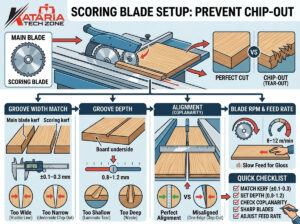
Laminated boards chip most on the underside, where the main blade teeth exit the board. A small scoring blade placed ahead of the main blade makes a shallow cut on the bottom face first, so the main blade exits through a pre-cut line instead of tearing the surface.
Scoring blade settings depend on your board and machine, and incorrect height or alignment is a very common cause of chip-out that gets blamed on the main blade. For step-by-step setup guidance, read our troubleshooting guide: Scoring Blade Setup on Sliding Panel Saws: Preventing Chip-Out on Laminated Boards.
Signs You’re Using the Wrong Tooth Design
Watch for these warning signs:
- Chipped laminate edges on the top or bottom face usually point to the wrong tooth type, a dull blade or a poorly set scoring blade.
- Burn marks can mean too fine a tooth count for your feed speed, a dull blade, or pitch and resin buildup.
- Rough or fuzzy edges often indicate worn teeth or too few teeth for the finish you need.
- Short blade life on MDF or particleboard suggests an ATB blade being used where TCG would last longer.
- Excess vibration or noise can come from a damaged or poorly tensioned blade, an incorrect arbor fit or a loose flange.
- Wavy or non-square cuts may involve the blade, but also check fence alignment and machine calibration.
Blade Maintenance Tips to Extend Life and Quality
Even the right blade will underperform if neglected.
- Clean regularly. Resin and glue buildup on teeth and plate increases friction and heat. Use a suitable blade cleaner, not harsh abrasives.
- Resharpen on schedule. Resharpening a blade before it becomes badly dull is cheaper and safer than waiting. Use a qualified service that matches the original tooth geometry.
- Inspect before every shift. Look for missing carbide tips, cracks in the plate and warping.
- Store blades properly. Keep them flat or hanging, with protective separation between teeth.
- Check flanges and arbor. Dirty or worn flanges cause vibration even on a perfect blade.
- Match feed speed to the blade. Feeding too fast overloads teeth; feeding too slow rubs and burns.
Machine Quality Matters Too
A good blade can’t fully compensate for a poorly built machine. Rigid construction, accurate fence systems, a stable sliding carriage and a quality motor all help the blade perform at its best. For a deeper look at what separates a high-performing machine, see our guide on what specific features of panel saws boost cutting speed and accuracy, and learn why the sliding panel saw was considered a major advancement in woodworking.
You can browse our full range of panel saw machines to find the right size and capacity for your production volume.
How Cutting Quality Affects the Rest of Your Production Line
A panel saw is the first step in most modular furniture workflows, so poor cuts travel downstream:
- Edge banding needs clean, square edges to bond properly. Chipped or rough edges cause glue-line gaps and peeling. See our guide on manual vs automatic edge banding and our range of edge banding machines.
- CNC drilling and routing depends on accurately sized panels for repeatable results. Explore our CNC router machines.
- Lamination and pressing work best on flat, clean-cut components. Our woodworking cold press machines and vacuum membrane presses rely on accurate, chip-free parts.
If you’re planning or upgrading a production floor, our guide on how to plan the workshop layout for a modern modular furniture factory shows where the cutting zone fits in the overall flow. For the bigger efficiency picture, read boosting efficiency and precision in woodworking with CNC technology.
The Cost Angle: Cheap Blades vs Right Blades
It is tempting to buy the cheapest blade that fits the arbor. But the true cost of a blade includes how many cuts it delivers per sharpening, how much rework it causes and how much downtime it creates. A premium TCG blade that lasts several times longer on laminated board and cuts cleaner often costs less per cut than a cheap one. To think about running costs more broadly, see calculating total cost of ownership (TCO) for CNC machines.
Quick Decision Checklist
Before you order your next blade, ask:
- What is my most common material: laminate, veneer, solid wood or mixed?
- Do I need a chip-free finish on both faces?
- Is my scoring blade installed and set correctly?
- What blade diameter and bore does my panel saw require?
- Is my feed rate suited to the tooth count I’m considering?
- Do I have a resharpening plan so the blade is serviced before it’s badly dull?
Frequently Asked Questions
Is ATB or TCG better for panel saws?
Neither is better in every case. ATB gives a sharp, clean shear on natural wood and veneered boards, while TCG is tougher and chip-resistant on laminates, melamine, MDF and particleboard. Choose based on your material.
Can I use a TCG blade on solid wood?
You can, but the finish is often not as clean as with an ATB blade. TCG is designed for durability on engineered and abrasive materials.
Why does my laminate chip on the bottom face?
The most common causes are a missing or misadjusted scoring blade, a dull main blade or the wrong tooth geometry. Check the scoring blade setup first.
What tooth count should I use on a panel saw?
Higher tooth counts suit laminated, thin or brittle boards where finish matters. Lower counts suit faster, rougher cuts. Follow the recommendations for your machine and blade diameter.
How often should I resharpen panel saw blades?
It depends on material, volume and how clean your cuts need to be. Resharpen as soon as you notice quality dropping, rather than waiting until the blade is badly dull.
Does the blade matter more than the machine?
Both matter. A quality machine with a mismatched blade underperforms, and a great blade on an unstable machine can’t deliver accurate cuts.
Final Thoughts
Selecting the right saw blade tooth design is one of the cheapest ways to improve cut quality, reduce rework and extend consumable life. Use ATB where you need a fine, shearing cut on natural wood and veneers. Use TCG where durability and chip resistance matter on laminates and engineered boards. Pair either one with the correct tooth count, hook angle and a well-set scoring blade, and keep the blade clean and sharp.
At Kataria Tech Zone, we help workshops and factories choose panel saws and complementary machinery that fit their materials and production targets. Browse our panel saw range, explore the full machinery lineup on our blog and product pages, or contact our team at +91-9878832923 for guidance on the right machine for your production.